Tuesday, March 28, 2017

A Year for Chartreuse

It’s finally happened; high fashion has come to Santa Fe River. By some inexplicable quirk of nature, the worlds of fashion and river guiding have overlapped...barely. (and, no, this has nothing to do with my funky old hat, which remains the epitome of poor taste).

The news reached me this morning as I drove home from a tour on Santa Fe River and it was delivered by a silky-voiced NPR host through the crackling speakers under my truck’s dashboard. Fashion leaders have determined that the color of the year for 2017 is chartreuse.”

At first, I didn’t recognize the story’s relevance to my life. It wasn't until the slow drive-through of a fast-food joint prompted me to Google “chartreuse” that I realized I had found the color—specifically, the name of the color—I had been seeking all day.
The events that led to this monumentally trivial revelation began an hour into this morning’s tour. Our small fleet of multi-colored kayaks had rafted loosely together over the gentle up-welling of Poe Spring. We were discussing North Florida's karst terrain and I was fumbling through an explanation of how these free-flowing “artesian” springs work, when a soft-spoken college girl asked the question on everyone's mind, “Why is the water such an ugly, yellow-green color?”

She had seen enough healthy artesian springs to know they are usually clear as glass and colorless. In deeper areas, when underlain by white sand or limestone the water has a beautiful blue cast. The deeper the water, the darker the blue. But the water now gushing from the darkened vent below us was exactly as she said, yellow-green and ugly.

Twenty years ago, Poe Spring looked much healthier. While it wasn’t as blue as other, larger springs along the river (probably because the pool floor was covered with gently waving meadows of dark green tape grass (Valsneria), Sagittaria and other submerged plants typical of the rich springs ecosystem) it was crystal clear and full of life. Fish, crayfish, snails, eels and other creatures thrived. That all changed in 2000 – 2001, when a series of surging floods and deep droughts pummeled the river. When the water levels returned to normal, Poe and nearby Lily Springs were noticeably darker. The change was made even more dramatic after severe drought in 2012 caused Poe Spring to essentially stop flowing.

A tour group of UF students frolic on the chartreuse waters of Poe Spring


These days, the color of Poe Spring fluctuates between dark brown when high, to yellowish-green during drier spells. During those low periods, the water table drops enough to allow brown river water to seep into the top of the aquifer where it mixes with the clear ground water. Researchers attribute the sickly, yellow-green color of Poe Spring to the mixing of blue-hued spring water with brown river water. Regardless of it's cause, the odd color has one benefit--it sparks conversations about the plight of the springs. And every time, our discussion stalls as we fumble to find suitable words to describe the water's color. Some people lean toward, “lime green.Others, “musk melon.” For me, no words have ever painted it quite so well as, “sickly, yellow-green” ....until today.

From this day forward, thanks to the fashion industry and a smooth-talking radio host, I will be able to tell people, with minimal awkwardness and mumbling, that the water now flowing from Poe Spring is chartreuse. Well, maybe "sickly chartreuse."

With that issue resolved, I am left with just one nagging question…. The color of the year!? Really?!


I told you that story so I can tell you this one...

*

When John and William Bartram explored Florida in 1765, they would have been heart-sick to learn that 250 years later, some of the miraculous blue springs they saw would be gone and the rest would be dying a slow, off-colored death. Being master word-smiths, I wonder how they would have described our foolishness in allowing this to happen. I also wonder what words they would have used to describe the sickly color of the water now flowing from Poe Springs. One word they would not have used was chartreuse. That word, at least as the name of a color, did not yet exist in 1765. In fact, the events that would give rise to the color name were happening at the exact same time as the Bartrams were in Florida.

In 1764, monks in the Grande Chartreuse Monastery (named for the Chartreus Mountains in which it was located) in the Artois Province of France were busy brewing a special concoction. The recipe had been gifted to the monastery 150 years earlier by François Hannibal d'Estrées, marshal of artillery to French king Henry IV, who had obtained it in China as an "elixir of long life." But concocting the magic elixir was no easy task, mainly because it required 130 ingredient. It wasn’t until 1737 that one of the monks was able to obtain all the ingredients and twisted up a batch. They called the elixir,Charteuse,” after the monastery.

In 1764, the monks tweaked the recipe and added some new ingredients. This new, “improved” version had a greenish color, so they called it Green Chartreuse. Being both magical and tasty, the drink was a hit. By the following century, it was being enjoyed throughout Europe. The name Chartreuse came to denote not only the drink, but also its yellow green color. So it was, that an elixir of eternal life gave us a word that describes some of Florida's dying springs.

The end…..

Thanks for stopping by. Please tip your waitress. Drive safe and I look forward to seeing you anoth...…..Wait! (screeeech) Did somebody say “elixir of long life?!” If you think I’m going to let that little nugget slip past without a closer look, you don’t know me. Take your seats! We’re heading back to 1764, back to the Artois region of France and back into the candle-lit halls of the Grande Chartreuse Monastery. We’re in luck, the merry monks are still huddled over their mixing bowls.

Moving in close, we peek over their shoulders. Maybe we can identify the 130 ingredients they are mixing into a bowl of water. But it’s no use. Aside from a few common spices, the formula for Chartreuse has been a closely held secret from that day to this.

Being mortal humans, we're always eager to learn the recipe of a life-giving elixir. Being Floridian humans, a people well-versed in the quest for magic elixirs, we know most such concoctions are full of "secret" ingredients. Two of the most common "known" ingredients are alcohol and spring water. It turns out, the elixir of Chartreuse is no different. The alcohol we know about, but what about the water? It seems they didn’t use rain or stream water like most people of the time, they had a well. And it wasn’t an ordinary well. This one flowed from deep in the earth…under its own power!

When the monastery of Chartreuse was first established in 1126, the monks drilled deep into the ground and hit water that was confined and pressurized under a confining layer of rock. The pressure was such that it pushed the water to the surface without any assistance; no pumping or well-bucket required. With time, more of these naturally free-flowing wells were dug, not only in the Artois Province but in other parts of the world, where similar geologic conditions had formed underground aquifers of pressurized water.

Today, these kinds of free-flowing wells are called by a name derived from "Artois," the region where they were discovered by the Chartreuse Monks. Regardless of whether it flows from natural chasms or from a dug well; if they it's cobalt blue, sulfur yellow or chartreuse green, any spring that flows freely from the ground under its own pressure is called “artesian.”

Tuesday, February 28, 2017

Deep Creek: An Explorer's Realm


Remote is good. But sometimes, "semi" remote, with a historic town, beautiful beaches and lots of restaurants and pubs relatively close-by (for some after-paddling fun) is even better. Deep Creek, twenty minutes from St Augustine in one direction and Crescent Beach/Matanzas in another, fits that bill perfectly. Best of all, it's wild. Aside from a relict railroad trestle that abuts the river on both sides at the half mile mark, there are no house, roads or signs of civilization anywhere along Deep Creek's entire five mile run to the St. Johns. In fact, if you were to land your boat and set off hiking in any direction, you'd find nothing but unbroken swamp forest for hours. This stream threads through the heart of the  5500 acre Deep Creek Conservation Area. 


A pair of yellow-crowned night herons
Wildlife
Most of this stream carries us through a densely shaded mixed-hardwood swamp forest, dominated by bald cypress, ash, tupelo red maple and several other wetland tree species. In certain seasons, the understory and shrub layers add color to the semi-tropical scene with blooms of wild roses, elderberries, leather flowers, climbing asters, climbing hemp and several species of morning glories. A beautiful stand of scarlet hibiscus crowds the bank close to the launch area. 

One lucky Double-crested cormorant, one not so much
Woodpeckers, kingfishers, wood ducks, anhingas, cormorants, barred owls and songbirds are our most frequent companions. Parula, black-and-white, yellow-rumped and several other warblers love this forest. In the summer, prothonotary warblers--a species that loves this kind of swamp hardwoods--are stars of the river-show. As we approach the St. Johns, we see more wading birds, including great blue and little blue herons, snowy and great egrets and, less frequently, night herons. 

River otters are especially fond of this quiet stream. We spot occasional turtles, but nowhere near the numbers we see on Santa Fe, Ichetucknee and other North Florida spring runs, where clear, calcium rich artesian water is nothing short of elixir. As on all Florida rivers, be prepared to spot an occasional gator or two (or three).

 
History
The struggle to bring civilization to the Deep Creek area and the nearby community of Hastings has been going on for as long as at nearby St. Augustine. But it proved far more challenging to mold a solid, lasting community from the fertile muck of the Lower St. Johns River basin than from the coquina rock of the coast.

For the Spanish outpost of Picolata, it was all about location, location, location. Situated alongside the relatively calm St. Johns River, only eighteen miles west of St. Augustine, Picolata was an excellent alternative landing for vessels carrying goods and passengers for St. Augustine that wanted to avoid St. Augustine’s treacherous sand bars. But, with the arrival of rail lines, shipping became less important for St. Augustine and Picolata was largely abandoned.
One of the largest early settlements in the Florida interior was Rollestown. The brainchild of an eccentric Englishman named Denys Rolles,the plan for  Rollestown was to use indentured English laborers to work a huge indigo plantation. By all accounts, Rolle was cruel and indecisive. From the outset, the venture was plagued with desertions. Those who stayed were not “colonists” in the traditional sense. An account written by a Dr. Stork called Rollestown, “a valuable colony of sixty people consisting of shoe blacks, chimney sweepers, sink boys, tinkers and tailors, bunters, cinder winches, whores and pickpockets.” (Is it just me, or does this sound like a great place tospend a few days?)

William Bartram in later years
At its peak, Rollestown had a population of 200 people and produced a variety of products including rice, naval stores, citrus and citrus products (including orange juice and orange wine) and indigo. When England lost Florida in 1784, Rolles was forced to abandon the settlement. He relocated to the Bahamas, where a couple of communities retain his name.
In 1765, a “battou” arrived at Rollestown carrying the famous explorer/botanist John Bartram and his son William. Months later, when John decided to wrap up the expedition and head back to Pennsylvania, William decided to stay and seek his fortunes in Florida. On a plantation near the mouth of Six-mile Creek, just north of Hastings, twenty seven year old William (and a handful of slaves provided by his father) tried his hand at raising indigo. As later revealed, the young naturalist’s heart lay with other pursuits and he abandoned the enterprise later that year.
A decade later, William Bartram returned to Florida on a venture more suited to his passions. With funding from a patron and friend of his father, William came to document the nature and people of Florida, with special emphasis on plants. Unlike his earlier ventures, this was a monumental success and resulted in the famous book Travels. Early on this second Florida expedition, William secured the help of one of Denys Rolle’s agents, a seasoned woodsman named Job Wiggins. Referred to in Travels as the “old trader,” Wiggins played a vital role in Bartram’s famous expedition, not only for his role as his guide and mentor, but also for loaning William the boat he used for much of the trip. Wiggins later established his own plantation near Hastings after Rollestown failed.

Water passage (w. Pam Daniels and Joanne Bolemon)
A half century later, John James Audubon spent a few days in this

 area. One notably miserable night aboard his boat, he was simultaneously assaulted by clouds of “blind musquitoes” and the stench of “jerkers” (an operation for jerking beef), “from which the breeze came laden with no sweet odors.”
With the outbreak of the Second Seminole War in 1835, plantations throughout Florida were converted to forts to protect local citizenry. Closest to Hastings was Ft. Hanson on the banks of Deep Creek. Several miles east and northeast of here were Forts Weedman and Harney. Settlers living south of Hastings could seek sanctuary at Fort Buena Vista on land now within the bounds of East Palatka, and Fort Hunter at the old site of Rollestown.
It wasn't until after the next war—the War of Union Aggression (as the settlers in this region liked to call the Civil War)—that today’s town of Hastings got its start. In 1890, Thomas Hastings established Prairie Garden, a large commercial vegetable farm, to feed the growing number of tourists now coming to St. Augustine and North Florida as part of a booming health spa industry. When Henry Flagler routed the Florida East Coast Railroad through the area, he called the train station “Hasting’s,” thereby solidifying both the town’s name and its importance as a source of vegetables and potatoes.
Judging from photo archives, one of the biggest celebrations ever held in the town of Hastings came in 1915. Grainy black-and-white photos show townsfolk and early model cars lining the roads of the small downtown business district. Banners and flags hang from every pole, telephone line and balcony in sight. Thumbing through the photos, we find a series taken of the parade. One shows a pair of sweet Southern belles in their finest “Sunday meetin’” dresses, holding parasols and riding horse-drawn buggies. Another shows pedestrians, horses and a variety of early model automobiles. The caption below one picture identifies the winner of “best decorated vehicle” of the parade. It’s a huge, open-topped vehicle similar to those used by European royals and dictators of that time, except for one distinctly Florida flourish—it’s covered in Spanish moss.
The cause for this celebration was news that the highly-sought Dixie Highway was going to be routed through Hastings with a connection to Orlando. The Dixie Highway was the latest incarnation of a series of Highway Associations that had their origins in the League of American Wheelmen, formed in 1880, whose motto was, “Lifting our People Out of the Mud.”


Skill Level


There is little current on this stream, which makes it suitable for all skill levels. With only one access point, it must be done as an out-and-back paddle (unless you want to do some of the St. Johns), which means you can tailor your trip length to suit your preference or ability. Being 

a 

small(ish) stream, there's always the possibility of new downfall, so be prepared for the possibility of having to get out for an occasional pull-over.
 

Monday, January 30, 2017

Dead Spring Running


Hornsby Spring Run


Hornsby Spring is dying. Once a deep blue gusher that added over 60 million gallons of cool artesian spring water to the Santa Fe River basin every day--the only first magnitude spring in Alachua County--its cobalt blue water has turned tannic brown.

The tipping point came in the early 2000’s, when a one-two punch of extreme drought followed closely by high flooding, caused the spring to reverse flow. Geologists call this kind of reversed spring an estevelle. When conditions returned to normal, Hornsby and a few other springs in the upper Santa Fe River basin were brown.


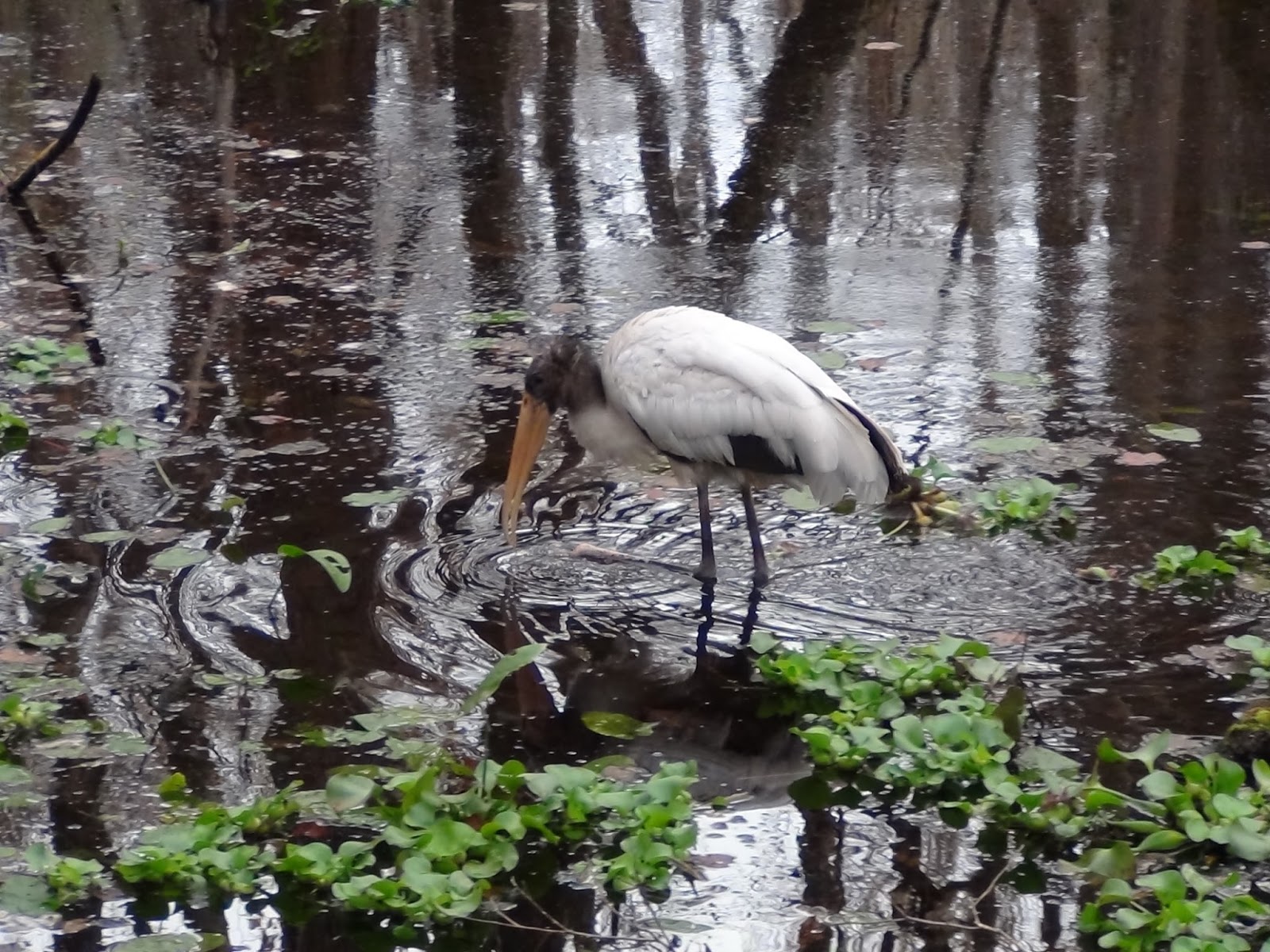
Wood stork plodding through Hornsby Swamp
People who love these springs visit them like concerned family members. We arrive with guarded optimism, pay quiet respects, conjure a few happy memories and then walk away saddened by the mounting acceptance that these springs are dying. 
Yes, the pool is still full and yes, the water that gushes from the vent still flows in an elegant stream through a spectacular swamp hardwood forest. But much of the water is brown river water that fell into the plumbing system and regurgitated by the same forces that have always powered the spring. Because we Floridians are pumping out more than is being replenished by rainwater (the source of all water in the aquifer) it contains less artesian water than it once did; less of the water that had filtered slowly through the limestone and re-merged only after a relatively-long residence time underground. This spring is as dying as surely as a lightning struck pine.

In my early years as an arborist, it took many hope-filled disappointments before I learned to confidently tell my customers that their beautiful, lightning-struck pine tree was dead as a rock, even though it was still vibrant green. I would point to the narrow streak running down the trunk and into the ground and explain that the trees roots were fried. But because the vascular system of xylem and phloem was still intact and it was still full of life-giving nutrients and water, it would continue going through the motions for weeks or even months to come. Like the death row prisoner who they call a “dead man walking,” these vibrant-looking pines were actually dead trees standing. Sometimes it would take as long as a year. But, in the end, the tree would die and I’d get the “you were right” call and we’d schedule a removal.


 Like the pine, the vascular system under Hornsby is still intact, still full of fluid. But it’s not the purely artesian spring water that once flowed from the vent, not the clear, calcium-rich water to which every habitat, every species and every individual creature that lives along the spring run and Santa Fe River, from here to the Gulf of Mexico, is adapted. The chemistry of tannic brown river water is different from artesian water. The temperature, too, is different. It’s also less clear, which means less light penetrates to the bottom and fewer plant species can thrive. Fewer plants means fewer animals. Many species have survived the transition. Some have not.


Just as I learned that green pines with lightning streaks running  into the ground are actually dead, I'm learning from watching Hornsby, Graham, Columbia and several other once-blue springs of the upper Santa Fe that, even though the plumbing is still working, browning springs are in their death-throes. But, there are a couple of big differences between dying pines and dying springs. 


For one thing, humans are not responsible for lightning struck trees. Insurance companies label them, “acts of God.” The death of our springs, on the other hand, is being caused by humans. It’s a reversible tragedy. But saving the springs would take special kind of miracle—a committed effort by Florida voters (that's us) and decision-makers we elect.